Surface Characterization
We perform detailed surface characterization to understand how materials and coatings behave before, during, and after environmental exposure.
These measurements provide the link between experimental testing and material performance by quantifying surface properties and their evolution.
Why Surface Characterization Matters
The performance of coatings and materials is strongly influenced by surface properties such as roughness, wettability, and microstructure.
Changes at the surface level can directly affect:
- Ice adhesion and shedding behavior
- Erosion resistance and degradation mechanisms
- Functional properties such as hydrophobicity
- Interaction with fluids and particles
Quantifying these properties is essential for understanding performance and guiding material development.
Measurement Capabilities
We employ a range of characterization techniques to analyze surface properties:
- Wettability measurements (contact angle and roll-off angle)
- Surface roughness analysis (profilometry)
- Microscopy (optical and electron-based methods)
- Chemical surface analysis (e.g. XPS)
These methods allow both qualitative and quantitative assessment of surface behavior.
Wettability & Surface Energy
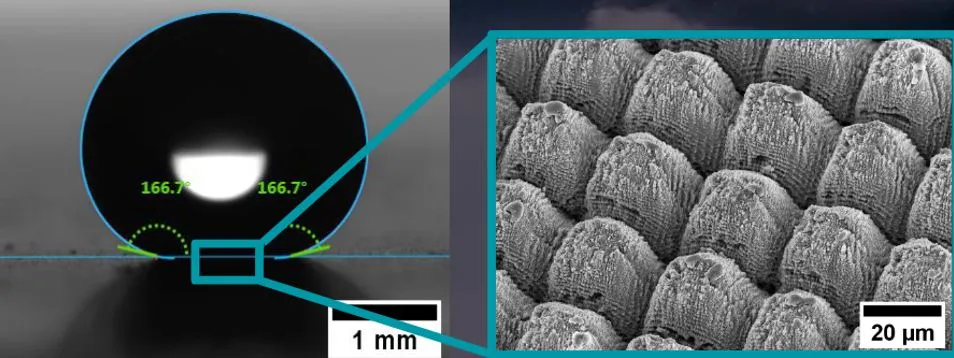
Wettability testing provides insight into how liquids interact with a surface.
We measure:
- Contact angle
- Roll-off angle
These parameters are critical for:
- Evaluating hydrophobic and icephobic coatings
- Assessing functional degradation after testing
- Understanding fluid–surface interaction mechanisms
Microscopy & Microstructure Analysis
Microscopy allows detailed investigation of surface morphology and material structure.
This includes:
- Optical microscopy for general surface inspection
- Scanning Electron Microscopy (SEM) for high-resolution analysis
These methods are used to:
- Identify defects and failure mechanisms
- Analyze particle impacts and erosion features
- Examine coating structure and degradation
Surface Roughness & Topography
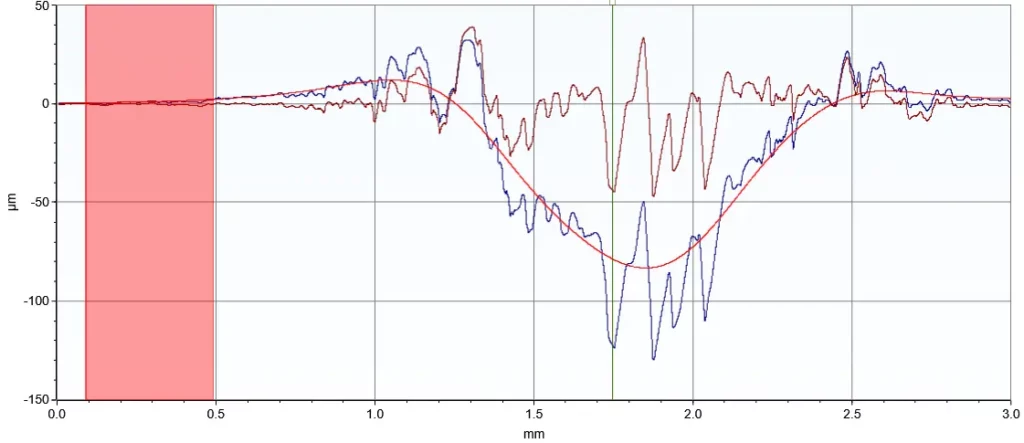
Surface roughness plays a key role in both icing and erosion behavior.
We perform:
- Profilometry-based roughness measurements (e.g. Dektak systems)
- Analysis of surface features and crater formation
This enables tracking of:
- Erosion progression
- Surface damage evolution
- Changes in functional surface structure
Chemical Surface Analysis
For advanced material studies, chemical composition can be analyzed using techniques such as:
- X-ray Photoelectron Spectroscopy (XPS)
This allows investigation of:
- Surface chemistry and composition
- Changes due to environmental exposure
- Coating functionality at the chemical level
Flexible Access to Characterization Tools
We combine in-house capabilities with extended access to additional instrumentation.
This includes:
- Direct access to in-house measurement systems
- Use of additional equipment through collaboration
- Integration of specialized analysis methods when required
This flexible approach ensures that appropriate characterization methods can be selected for each specific investigation.
Measurement & Evaluation
Surface characterization is typically integrated with experimental testing.
This enables:
- Comparison of surface properties before and after exposure
- Correlation between surface changes and performance
- Identification of degradation mechanisms
These insights support both material development and validation.
Typical Use Cases
Surface characterization supports:
- Evaluation of coating performance and durability
- Analysis of erosion and icing effects on surfaces
- Investigation of functional surface properties
- Development of advanced material systems
Frequently Asked Questions
What types of surfaces can be analyzed?
Coatings, metals, polymers, and structured surfaces can all be characterized.
Are measurements performed before and after testing?
Yes, surface characterization is typically used to track changes due to environmental exposure.
Can different techniques be combined?
Yes, multiple methods are often combined to obtain a complete understanding of surface behavior.
Is this only for research purposes?
No, surface characterization is used for both research and application-driven development.