Ice Accretion & Icing Phenomena
Ice accretion is a complex physical process governed by the interaction of airflow, geometry, and environmental conditions.
We perform experimental investigations of ice formation on components and surfaces to support both fundamental research and application-oriented development.
Why Ice Accretion Matters
Icing does not follow a single, predictable behavior. The formation and growth of ice depend on multiple interacting factors, including:
- Flow field characteristics around the geometry
- Surface properties and temperature
- Droplet size and liquid water content
- Icing type (e.g. rime, glaze, or mixed ice)
Small changes in these parameters can lead to significantly different ice shapes and growth dynamics.
Understanding these effects is essential for:
- predicting ice formation
- improving simulation models
- developing effective mitigation strategies
Experimental Investigation of Ice Accretion
We study ice formation on a wide range of geometries, from simplified test samples to application-relevant components.
This includes:
- Aerodynamic profiles (e.g. airfoils, leading edges)
- Structural elements (e.g. cables, supports)
- Complex component geometries (e.g. probe holders, sensor housings)
Testing under controlled conditions allows systematic variation of parameters and direct observation of resulting ice structures.
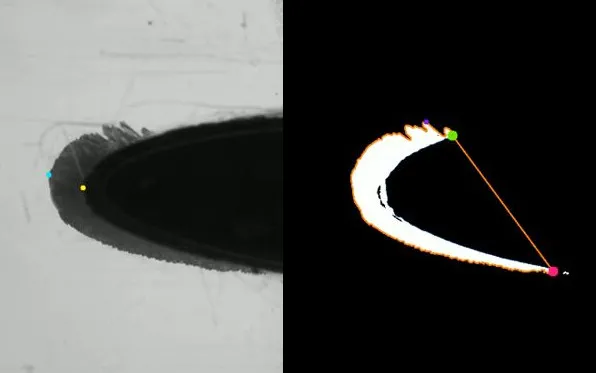
Ice accretion test with ice tracing
Icing Conditions and Ice Types
Different icing conditions lead to fundamentally different ice morphologies and behaviors.
We investigate:
- Rime ice formation (typically low temperature, small droplets)
- Glaze ice formation (higher temperatures, larger droplets, more complex structures)
- Mixed icing conditions
These differences strongly influence:
- ice shape and roughness
- adhesion and shedding behavior
- impact on aerodynamic performance
Measurement & Analysis
Ice accretion is evaluated using both qualitative and quantitative methods.
This includes:
- Measurement of ice shape and geometry
- Determination of ice mass and volume
- Time-resolved observation of ice growth
- Comparative analysis under varying conditions
Custom-developed in-house tools enable efficient evaluation and comparison of test results.
While three-dimensional optical volume estimation of ice is inherently challenging—particularly for transparent ice types—we continuously expand our capabilities and are open to further developments in this area.
Applications
Ice accretion studies support:
- Development and validation of icing simulation models
- Fundamental research on icing physics
- Evaluation of geometric influences on ice formation
- Support for design of ice protection systems
Relevant Industries
Ice accretion testing is particularly relevant for:
- Aerospace and aviation
(e.g. aerodynamic surfaces, sensors, exposed structures) - Research institutions and simulation developers
(e.g. model validation, low TRL development) - Energy and infrastructure
(e.g. cables and exposed structural elements) - Systems operating in icing environments
(e.g. sensors and components exposed to airflow and moisture)