Ice Adhesion Test Rigs
We perform ice adhesion measurements using complementary experimental setups designed to capture both static and dynamic adhesion behavior under controlled conditions.
These setups enable efficient comparison of materials, coatings, and surface treatments across different icing scenarios.
Test Approaches
Dynamic Ice Adhesion (Wind Tunnel)
Ice adhesion can be measured directly in the icing wind tunnel under realistic icing conditions.
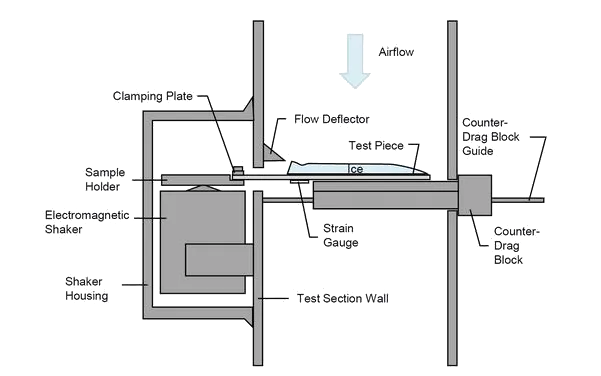
This is achieved using a vibrating cantilever setup, where the sample is exposed to icing while undergoing controlled oscillation.
Key characteristics:
- Adhesion measurement under rime, glaze, and mixed icing conditions
- Ice formed dynamically under airflow
- Measurement of adhesion after accretion
This approach captures adhesion behavior under realistic conditions, where ice forms and interacts with the surface in a coupled flow and thermal environment.
Due to the measurement principle, samples must allow for slight elastic deformation.
Substrate materials
Metals (e.g., Aluminium, Titanium)
Ice type
Formed under realistic icing conditions
Accretion area dimension
13 mm x 70 mm
Static Ice Adhesion (Ice Cube Method)
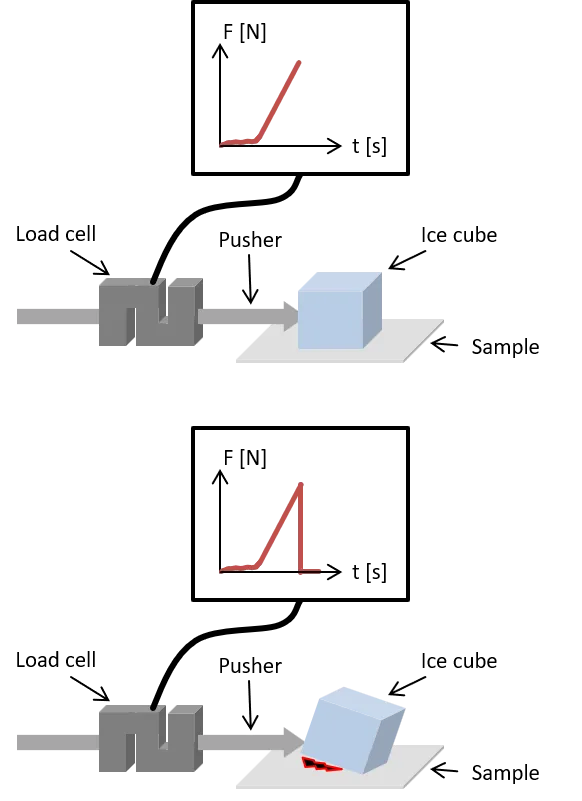
For materials that are brittle or not suitable for dynamic testing, we use a shear-based ice adhesion test.
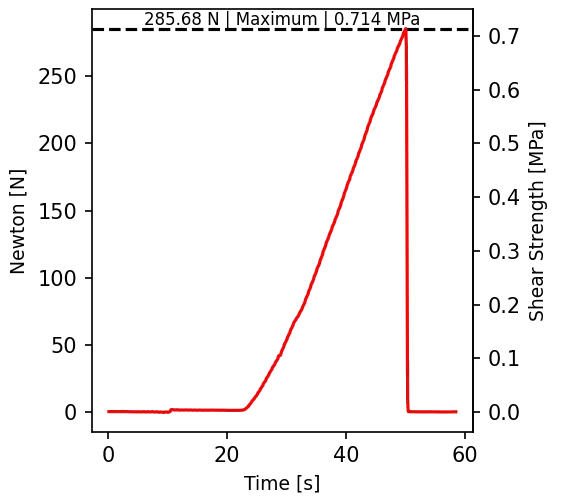
A defined ice cube is frozen onto the sample surface and mechanically removed while measuring the required force. The measured force is converted into shear stress, enabling direct comparison between different materials.
This method is particularly suited for rapid screening and evaluation of coating performance.
Ice cube dimensions
20 mm x 20 mm
Substrate materials
All substrates and surface treatments
Maximum shear stress
2.5 MPa
Example of a shear strength measurement
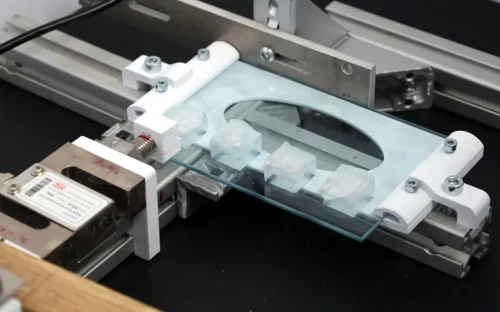
With the ice cube pusher test, we can rapidly screen paints, surface treatments, or materials and their capabilities as passive ice protection systems. This method provides a quick and efficient way to evaluate how well different coatings and materials prevent ice from adhering to surfaces, crucial for developing more effective anti-icing solutions.
Ice cube pusher test rig
Enhanced Static Testing Approach
While conventional static tests provide highly reproducible baseline data, they do not fully represent ice formed under dynamic icing conditions.
To address this, we apply a modified ice formation procedure that increases the similarity to impact icing. By controlling the freezing conditions, the structure of the ice–surface interface is altered, reducing the presence of entrapped air and increasing interfacial contact.
This results in:
- higher measured adhesion forces
- improved differentiation between coating performance
- better correlation to dynamically formed ice
Static testing therefore provides a controlled baseline, while enhanced procedures allow partial approximation of more realistic icing conditions without the complexity of full airflow testing.
Sample Compatibility
The combined setups allow testing of a wide range of materials:
- Flexible samples (for cantilever-based testing)
- Brittle materials such as glass and ceramics
- Coated and uncoated surfaces
- Flat samples and simple geometries
This ensures that appropriate test methods can be selected depending on material properties and application requirements.
Measurement & Evaluation
Ice adhesion is evaluated through:
- Force-based measurement of ice detachment
- Conversion to shear stress for material comparison
- Observation of detachment behavior and failure modes
- Comparative testing across different icing conditions
The combination of static and dynamic methods provides a more complete understanding of ice–surface interaction.
Test Efficiency & Throughput
The ice adhesion setups are optimized for efficient comparative testing.
Key advantages include:
- Rapid screening of multiple coatings and materials
- Repeatable test conditions for reliable comparison
- Selection of appropriate test method depending on material type
The ice cube method enables particularly fast evaluation cycles, while the wind tunnel setup provides more realistic but more involved testing.
Typical Test Scenarios
The ice adhesion rigs are used for:
- Screening of anti-icing and icephobic coatings
- Comparative evaluation of surface treatments
- Investigation of adhesion differences between icing types
- Support for hybrid ice protection system development
Frequently Asked Questions
Which method should be used for my material?
Flexible samples can be tested using the cantilever setup in the wind tunnel, while the ice cube method allows to also evaluate brittle or rigid materials.
What is the advantage of combining both methods?
Static tests provide fast screening, while dynamic tests represent realistic icing conditions.
How quickly can tests be performed?
Static adhesion tests allow rapid evaluation, while wind tunnel tests require more setup but provide more representative results.
Can different icing types be tested?
Yes, dynamic testing in the wind tunnel allows investigation of rime, glaze, and mixed ice conditions.