Sand Erosion Testing Facility
Within our cooperation with Airbus, SurfLabX operates the Airbus Plint TE 68 gas jet sand erosion rig for various research and characterization topics.
The facility enables controlled investigation of coating and material degradation under solid particle impact.
Sand erosion tests are performed according to ASTM G76-18
(Standard Test Method for Conducting Erosion Tests by Solid Particle Impingement Using Gas Jets).
Test Principle
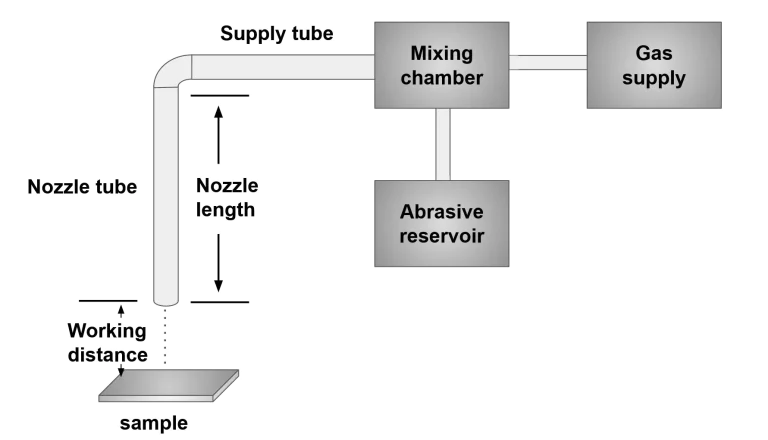
The Plint TE 68 sand erosion rig is based on the gas blast method, where particles are introduced into a gas stream and accelerated through a nozzle to achieve controlled impact conditions. Particles are fed via a rotating disk, mixed with compressed air, and accelerated through a nozzle toward the sample.
Sand mass flowrate
2 g/min
Standard impact speed
55 m/s
Sand particle materials
Quartz sand, grain size 60/85 (D ≈ 220 µm), other erodents, e.g., volcanic ash
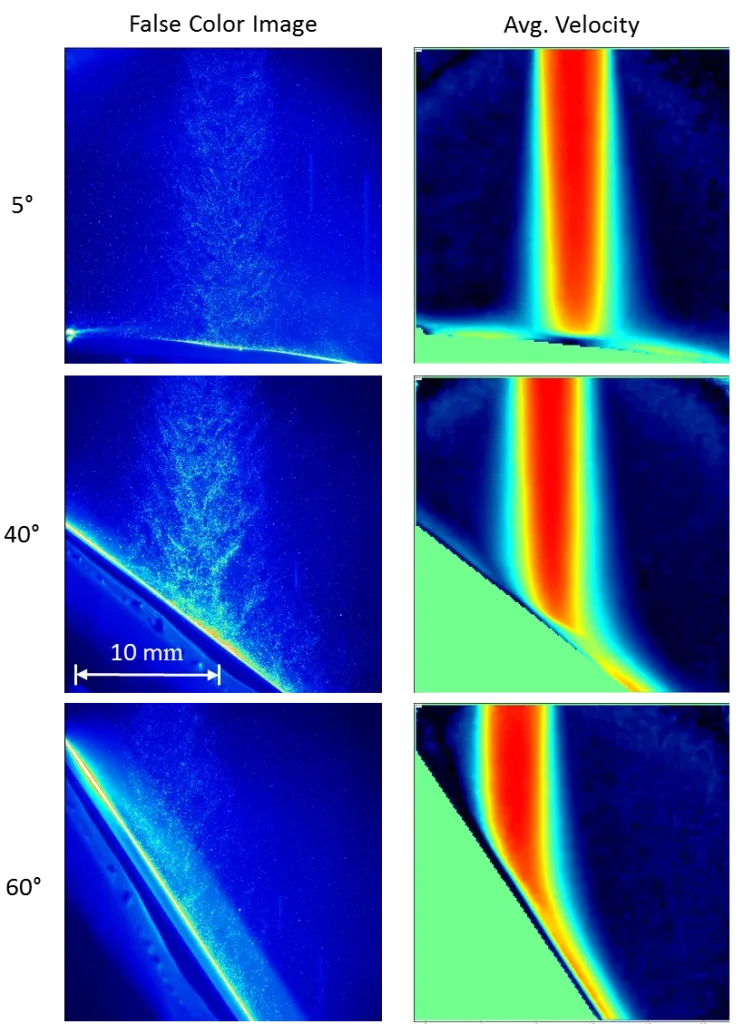
Impact angles
20° – 90°
Sample Configuration
Samples are mounted in a holder with adjustable impact angle and positioned at a fixed distance of approximately 20 mm from the nozzle.
Typical sample size:
- 50 × 50 mm
The setup enables controlled and repeatable exposure of the same sample over multiple test steps.
Time-Resolved Testing Approach
In contrast to droplet-based erosion testing, sand erosion is typically performed as a stepwise exposure process.
A single sample is subjected to repeated particle loading under identical conditions.
The test sequence follows:
- Exposure to a defined mass of particles
- Removal of the sample
- Characterization of the surface
- Re-insertion and continued exposure
This process is repeated to track the evolution of material degradation over time.
Measurement & Evaluation
After each exposure step, the sample is characterized using multiple methods:
- Mass measurement to quantify material loss
- Macroscopic imaging to observe erosion features
- Surface roughness measurements to characterize surface topography changes
- Optional wettability testing (e.g. contact angle) to assess functional degradation
This allows detailed tracking of how coatings degrade with increasing particle exposure.
Parameter Control
The facility allows controlled variation of:
- Particle velocity (via pressure conditions)
- Mass flow rate
- Impact angle
- Total particle mass applied
This enables systematic investigation of erosion behavior under different conditions.
Test Efficiency & Insight
The time-resolved testing approach provides:
- Continuous monitoring of degradation
- Direct correlation between particle exposure and material loss
- Identification of critical damage thresholds
This makes the facility particularly suitable for understanding erosion mechanisms and evaluating long-term coating performance.
Typical Test Scenarios
The sand erosion facility is used for:
- Evaluation of erosion-resistant coatings
- Investigation of material degradation mechanisms
- Comparison of different surface systems
- Assessment of functional performance loss (e.g. hydrophobicity)
Frequently Asked Questions
What distinguishes sand erosion testing from rain erosion?
Sand erosion testing focuses on cumulative material loss and degradation over time, rather than localized impact events.
Can degradation be tracked over time?
Yes, the same sample is repeatedly characterized, enabling time-resolved analysis.
What measurements are performed?
Mass loss, surface roughness, microscopy, and optionally wettability measurements.
Is the testing suitable for detailed analysis?
Yes, the setup is particularly suited for studying degradation mechanisms and long-term performance.