Aircraft, UAV and Drone Ice Protection Systems for Fixed Wings, Propellers and Sensors
SurfLabX helps aerospace teams develop and validate ice protection systems for aircraft, UAVs, drones and eVTOLs.
We combine engineering support, rapid prototyping and controlled icing wind tunnel testing to assess how deicing, anti-icing, electrothermal and hybrid protection concepts perform on exposed components such as propellers, sensors and airframe surfaces.
Why Ice Protection Systems Matter
Ice protection systems must ensure reliable operation under varying environmental conditions, such as “standard” supercooled liquid water droplet icing in glaze, rime or mixed conditions or ice crystal icing, among others, while operating within strict constraints such as limited available power or system integration requirements such as limited weight, voltage and current requirements from the aircraft, structural integrity and others.
Achieving this balance is challenging, as system performance depends on multiple interacting factors including geometry, material selection, and operating strategy.
Testing under controlled conditions is therefore essential to:
- verify system effectiveness under icing exposure
- identify performance limitations
- optimize energy consumption
- compare different system concepts and materials
Aircraft, UAV, Drone and UAS Ice Protection Applications
Ice protection systems are applied across a wide range of unmanned aircraft components and geometries. We test manned and unmanned aircraft and rotorcraft ice protection concepts on representative components, simplified samples and application-specific hardware.
Typical test articles include:
- aircraft leading edges and other surfaces prone to icing conditions
- fixed-wing UAV leading edges and exposed aerodynamic surfaces
- small UAV ice protection components and representative geometries
- drone propellers and UAV propeller deicing system concepts
- sensors, probes and ice detection sensor for UAVs
- flat or simplified samples for fundamental deicing and anti-icing studies
This allows both application-specific testing and controlled studies of the physical effects that determine ice accretion, ice shedding and system performance.
Drone Propeller Ice Protection and UAV Component Heating
Propellers, leading edges, air inlets, sensors and exposed UAV components are highly sensitive to icing. SurfLabX supports the development and testing of propeller ice protection systems and UAV component heating concepts.
Testing can include electrothermal heating, localized heating, hybrid heating/coating concepts, ice shedding observation and performance comparison under controlled icing wind tunnel conditions.
Electrothermal Ice Protection Systems
Electrothermal systems are among the most widely used ice protection approaches.
We evaluate:
- Heating performance under icing conditions
- Ice accretion and shedding behavior
- Influence of heating power and distribution
A key challenge is energy efficiency, particularly for systems with limited available power.
We investigate strategies such as:
- Multi-zone heating concepts
- Optimized power distribution
- Localized heating approaches
Hybrid Ice Protection: Heating, Coatings and Surface Effects
Combining passive coatings with active heating can significantly improve system performance.
We investigate:
- Influence of hydrophobic or icephobic coatings on ice shedding
- Reduction of required heating power
- Performance differences between anti-icing and de-icing operation
These hybrid approaches are particularly relevant for energy-constrained systems.
Testing of passive and active Ice Protection Systems (IPS)
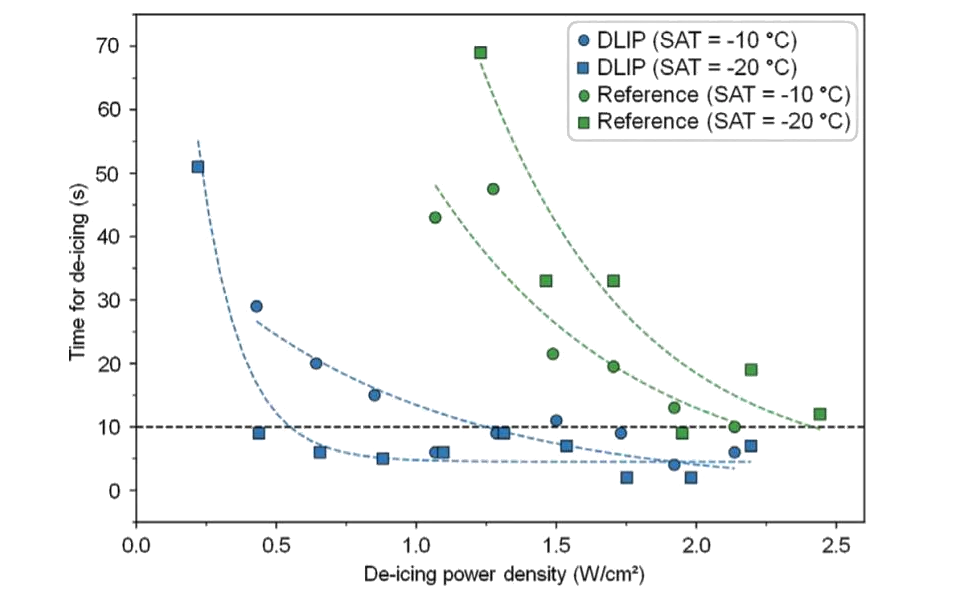
We conduct tests on active and passive anti-icing and de-icing technologies to determine their power requirements and operational efficiency. This enables the assessment of novel technologies, and the fine-tuning of system settings to achieve optimal performance with reduced energy consumption.
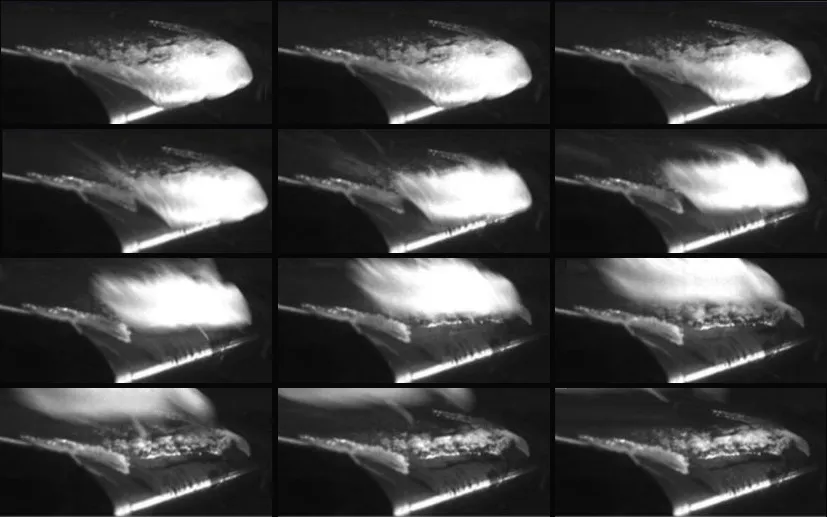
High Speed Recording of Ice Shedding
Characterization of de-icing times
Ice Protection Materials and System Concepts
Ice protection systems are not limited to a single material or technology.
We test and compare different approaches, including:
- Conventional resistive heating materials
- Novel materials such as conductive coatings or printed systems (e.g. graphene-based inks)
- Multifunctional coatings combining structural and heating functionality
This allows identification of material systems best suited for specific applications.
System Integration and Design Parameters
System performance is strongly influenced by design choices.
We evaluate:
- Placement of heating elements (internal vs. external)
- Interaction between system design and component geometry
- Sensitivity to operating conditions
Testing helps identify which configurations are effective and where improvements are required.
Alternative Ice Protection Approaches
In addition to electrothermal systems, we investigate alternative concepts such as:
- Chemical ice protection (e.g. de-icing fluids)
- Combined systems involving coatings and chemical treatments
- Electromechanical systems
- Emerging approaches such as plasma-based systems
For example, we evaluate the interaction between de-icing fluids and coatings, including runoff behavior and the impact on surface functionality.
Surface characterization after application can be used to assess whether coating properties are maintained.
Measurement & Evaluation
Ice protection system performance is evaluated through:
- Visual observation of ice accretion and shedding
- High-speed imaging of ice removal processes
- Correlation between system operation and icing behavior
- Surface characterization before and after testing
This enables both qualitative and comparative assessment of system effectiveness.
UAV Icing Conditions and Certification Support
Ice protection systems are typically developed to maintain functionality under icing conditions, but the underlying challenges—energy efficiency, thermal management, and system integration—are relevant across a wider range of applications.
We support testing and development for:
- De-icing and anti-icing of aerodynamic components
- Prevention of blockage or malfunction in exposed sensors and measurement devices
- Thermal management of components operating in cold environments
- Optimization of heating systems under limited power availability
- Evaluation of hybrid systems combining heating, coatings, or chemical treatments
Beyond classical icing scenarios, similar approaches can be applied to any system where controlled heating is required under constrained conditions.
Relevant Industries
Ice protection and thermal management systems are relevant across a wide range of industries where environmental exposure and energy constraints play a role.
This includes:
- Aerospace and aviation
(e.g. aircraft systems, UAVs, sensors, aerodynamic components) - Space systems
(e.g. components exposed to extreme thermal conditions) - Defense and high-performance systems
(e.g. rapidly developed platforms with strict energy limitations) - Automotive and mobility
(e.g. sensors, cameras, and exposed components in cold environments) - Energy and infrastructure
(e.g. exposed systems requiring environmental protection) - Battery-powered and portable systems
(e.g. devices operating under limited energy availability)
These systems often share common challenges related to power consumption, system integration, and environmental robustness.