High-Speed Imaging
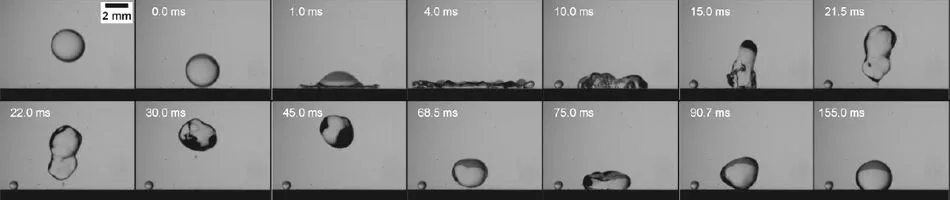
We utilize high-speed imaging to capture and analyze fast physical processes that are not visible with conventional measurement techniques.
This enables detailed investigation of transient phenomena such as impacts, fluid interactions, and rapid mechanical events.
Measurement Principle
High-speed cameras record image sequences at extremely high frame rates, allowing fast processes to be resolved in time.
Our systems enable:
- Frame rates from tens of thousands up to millions of frames per second
- Exposure times down to the sub-microsecond range
- High spatial resolution combined with high temporal resolution
This allows visualization of events that occur on microsecond timescales.
Measurement Capabilities
High-speed imaging can be applied to a wide range of physical processes, including:
- Droplet and particle impacts
- Ice accretion and fragmentation processes
- Erosion phenomena (rain and sand)
- Flow visualization in wind tunnels and sprays
- Mechanical motion and deformation
- Ballistic and high-speed impact events
These measurements provide direct insight into dynamic processes that are otherwise difficult to quantify.
Experimental Setup
The camera system can be integrated into different experimental environments, including:
- Wind tunnel setups
- Erosion testing rigs
- Mechanical test setups (e.g. tensile and fracture testing, etc.)
- Welding assemblies (e.g. Powder Bed Fusion (PBF), Gas Metal Arc Welding (GMAW / MIG), Laser Beam Welding (LBW), Wire Arc Additive Manufacturing (WAAM), Plasma Arc Welding (PAW), Cold Metal Transfer (CMT)
- Qualification tests (e.g. Vibration and shaker, drop and impact, pyroshock, mechanism deployment, valve/actuator motion, rotor dynamics)
- Custom experimental configurations
Flexible triggering and synchronization allow precise timing of image acquisition relative to the physical event.
Data Analysis & In-House Software
Beyond image acquisition, we develop proprietary in-house software to analyze recorded sequences.
This enables:
- Tracking of particles or features over time
- Measurement of velocities, trajectories, and deformation
- Extraction of quantitative data from image sequences
- Automated evaluation of large datasets
This transforms high-speed imaging from a visualization tool into a quantitative measurement method.
Measurement & Data Quality
The imaging system provides:
- High light sensitivity (ISO up to ~50,000 for monochrome sensors)
- High dynamic range for detailed image capture
- Flexible region-of-interest (ROI) for optimizing frame rate and resolution
This ensures reliable capture of fast and low-light processes.
Test Efficiency & Workflow
High-speed imaging workflows are optimized for efficient experimentation:
- Fast setup and integration into existing test rigs
- Immediate visualization of results
- High-speed data transfer and storage
- Ability to record multiple events in quick succession
Memory segmentation allows recording of new events while previous data is being processed, improving throughput.
Typical Use Cases
High-speed imaging is used for:
- Understanding impact and fragmentation processes
- Investigating icing and erosion phenomena
- Visualizing flow behavior
- Supporting development and validation of physical models
Frequently Asked Questions
What kind of processes can be recorded?
Any fast process involving motion, impact, or fluid interaction, typically in the microsecond to millisecond range.
Is high-speed imaging only qualitative?
No, image sequences can be analyzed quantitatively using tracking and measurement algorithms.
Can the system be integrated into existing tests?
Yes, the camera can be integrated into various experimental setups and synchronized with external triggers.
How fast are the recordings?
Depending on resolution, frame rates range from thousands to several million frames per second.
Is this a standalone service?
High-speed imaging is typically used in combination with other testing methods to enhance understanding of physical processes.