Ice Adhesion & Icing Performance
Ice adhesion testing focuses on quantifying how strongly ice interacts with a surface under controlled conditions. As part of our broader work, we evaluate coating performance under both static and dynamic icing scenarios to enable direct comparison of materials and support the development of anti-icing and ice protection solutions.
These investigations are typically carried out at component level using controlled experimental setups, including a dedicated Icing Wind Tunnel and specialized Ice Adhesion test rigs.
Why Ice Adhesion Matters
Low adhesion can enable passive ice shedding or reduce the energy required for active de-icing systems. In contrast, high adhesion promotes ice accumulation, leading to performance degradation and potential safety risks.
Quantifying ice adhesion under controlled conditions is therefore essential for:
- comparing coating performance across materials
- supporting the development of anti-icing strategies
- evaluating hybrid solutions in combination with ice protection systems
Understanding adhesion is also closely linked to how ice forms and grows on surfaces. If you’re interested in the underlying physics, see our work on Aviation & Aircraft Icing Research.
Static Ice Adhesion
Static ice adhesion testing provides a controlled and repeatable method to quantify the force required to detach ice from a surface.
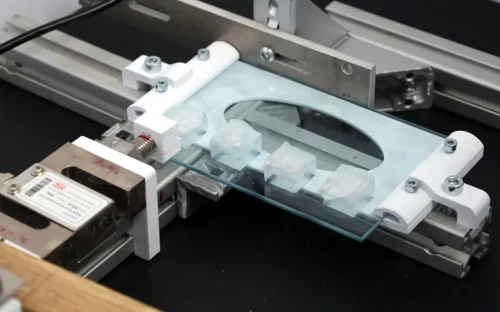
The most widely used approach is the ice cube adhesion test. A defined ice volume is frozen onto the sample surface under controlled conditions and subsequently removed while measuring the required force. This force is converted into shear stress, which enables direct comparison of adhesion performance across different materials and coatings.
This method is particularly suited for:
- rapid screening of coatings and surface treatments
- comparative evaluation under standardized conditions
- testing of brittle materials such as glass, ceramics, and coated substrates
Enhanced Static Testing Approach
While conventional static tests provide highly reproducible baseline data, they do not fully represent ice formed under dynamic icing conditions.
To address this, we apply a modified ice formation procedure that increases the similarity to impact icing. By controlling the freezing conditions, the structure of the ice–surface interface is altered, reducing the presence of entrapped air and increasing interfacial contact.
This results in:
- higher measured adhesion forces
- improved differentiation between coating performance
- better correlation to dynamically formed ice
Static testing therefore provides a controlled baseline, while enhanced procedures allow partial approximation of more realistic icing conditions without the complexity of full airflow testing.
Impact Ice Adhesion Testing (Wind Tunnel)
To capture adhesion under realistic operating conditions, we perform ice adhesion measurements under dynamic icing in controlled airflow environments.
In these tests, ice forms directly on the surface under defined conditions of:
- airflow velocity
- temperature
- droplet size and liquid water content
Testing is conducted in a controlled icing environment, where parameters can be adjusted to reproduce different icing regimes such as rime or glaze ice.
Measurement Principle
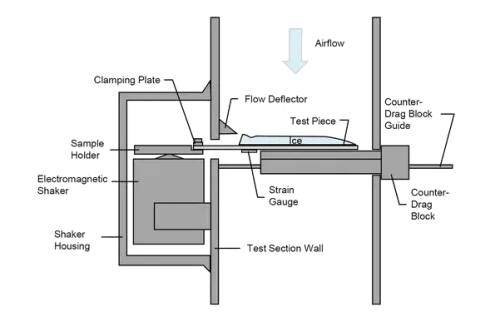
Adhesion is measured using a cantilever-based method integrated into the test setup.
A flexible sample is mounted and exposed to icing conditions until a defined ice layer has formed. After ice accretion, the system is excited mechanically at its natural frequency. The vibration amplitude is gradually increased until the ice layer detaches.
During this process:
- the mechanical response of the sample is continuously monitored
- the detachment event is identified through a distinct change in signal response
- the corresponding strain level is used to calculate the shear stress at the ice–surface interface
Key Advantages
This approach enables:
- measurement of adhesion for ice formed under realistic conditions
- evaluation of airflow and droplet impact effects
- comparison of coating performance under dynamic accretion
In contrast to static methods, dynamic testing captures the coupled interaction between flow, temperature, and ice formation.
Comparison of Methods
Static and dynamic adhesion measurements serve complementary purposes:
- Static testing → controlled, fast, highly reproducible baseline data
- Dynamic testing → realistic icing conditions and system-relevant behavior
Using both approaches allows efficient screening combined with high-fidelity validation.
Sample Compatibility
Testing is performed primarily on flat substrates.
- Static tests → suitable for a wide range of materials, including brittle substrates
- Dynamic tests → require samples with sufficient flexibility for vibration-based measurement
Typical samples include coated metal substrates, glass, and engineered surface materials. Component-level samples can be evaluated where geometry and mounting allow.
Measurement & Performance Evaluation
In addition to adhesion measurements, we evaluate coating performance through complementary measurements before and after icing exposure, as well as during ice detachment.
This includes:
- surface condition assessment before and after icing exposure, e.g. hydrophobicity through contact angle and roll off angle measurements
- analysis of coating degradation due to repeated icing cycles, e.g. roughness measurements and microscopic images
- high-speed imaging of ice detachment behavior and failure modes
- comparative testing across multiple samples and conditions
These measurements provide additional context for adhesion results and help assess the robustness and repeatability of coating performance under realistic conditions.
Applications
Ice adhesion testing supports:
- development of anti-icing coatings
- hybrid ice protection systems (coating + active systems)
- aerodynamic components exposed to icing
- sensors and small-scale components
For system-level considerations, see Ice Protection Systems, where adhesion directly affects required heating power and system efficiency.
For a deeper understanding of how ice forms and behaves on different geometries, refer to Ice Accretion & Icing Phenomena.
Relevant Industries
Ice adhesion testing is relevant in applications where ice formation affects performance, safety, or functionality, including:
- Aerospace and Aviation (e.g. aerodynamic surfaces, air data systems, sensors, ice protection systems) This includes both conventional aircraft and emerging platforms. For smaller and more energy-constrained systems, see UAV, Drone & eVTOL Testing, where coating performance can significantly influence system feasibility.
- Energy, Transportation and Infrastructure (e.g. power lines, cables, and exposed structures or vehicles subject to icing conditions)
- Systems Operating in Cold Environments (e.g. exposed sensors, optical systems, and instrumentation)