Rain Erosion Testing Facility
Within our cooperation with Airbus, SurfLabX operates the Airbus Pulsating Jet Erosion Test Rig (PJET) for various research and characterization topics.
The facility enables controlled rain erosion testing of coatings and materials under realistic high-speed droplet impact conditions.
Rain erosion tests are performed according to ISO/TS 19392-3:2018-04.
Test Principle
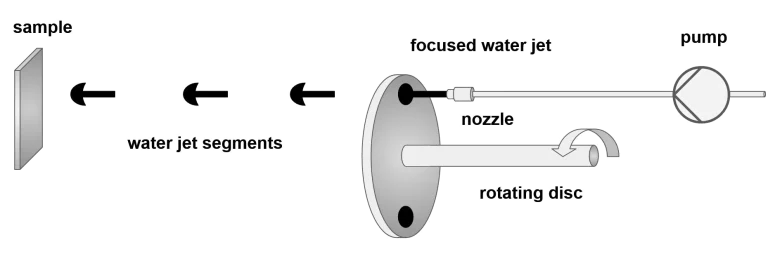
The PJET simulates high-speed droplet impact by generating discrete water jet segments that replicate rain conditions encountered by aircraft and exposed components. High-pressure water is expelled through a nozzle to form a focused jet, which is segmented by a rotating disc to create individual impact events.
This setup reproduces conditions equivalent to heavy rain exposure at high velocities, enabling realistic erosion testing.
Impact frequency of water jet segments
40 Hz
Jet impact speed
up to 225 m/s
Water jet front diameter
~2 mm
Impact angles
20° – 90°
Sample Configuration
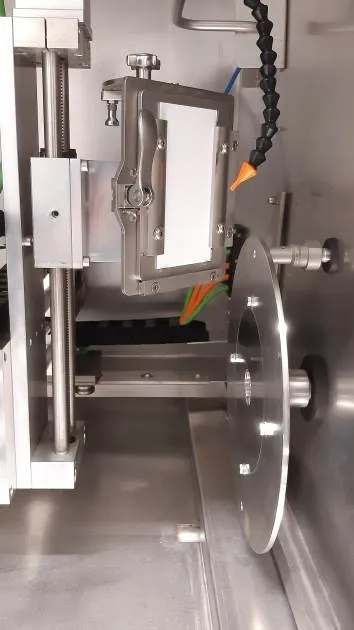
Samples are mounted on a programmable YZ stage, allowing precise positioning and controlled exposure.
Typical sample size:
- 150 × 80 mm
- thicknesses usually in the millimeter range, but thicknesses in the centimetre range are also possible
The setup enables:
- Movement of the sample in a defined grid pattern
- Application of multiple test conditions on a single specimen
- Variation of impact angle relative to the jet
This allows efficient utilization of each sample and direct comparison of different conditions.
Parameter Variation & Test Control
The PJET allows controlled variation of key test parameters:
- Impact velocity (via water pressure) up to 225 m/s
- Number of impacts per location (regimes up to 1,000,000 impacts and more)
- Impact angle (ranging from 20° to 90°)
- Exposure pattern across the sample (maximum nine different numbers of impacts)
- up to five repetitions per condition.
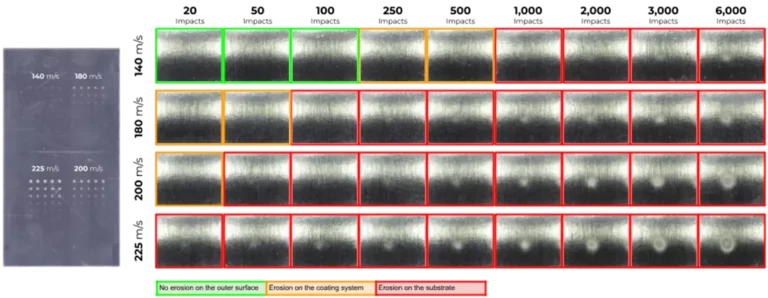
Due to the localized impact area, multiple parameter combinations can be applied side-by-side on a single sample, enabling structured evaluation of coating performance.
Measurement & Evaluation
Testing is supported by detailed surface characterization of individual impact locations.
This includes:
- Macroscopic and microscopic imaging of erosion features
- Identification of failure mechanisms
- Comparative analysis across different test conditions
- Optional wettability testing to assess functional degradation
This enables both rapid screening (e.g. failure vs. no failure) and detailed investigation of progressive erosion behavior.
Test Efficiency & Throughput
The facility is optimized for efficient testing campaigns.
Key advantages include:
- Multiple parameter variations on a single sample
- Reduced number of required specimens
- Rapid comparison of coating performance
This allows fast identification of critical performance limits and supports efficient material development.
Visual inspection and classification of impact parameter combinations
Typical Test Scenarios
The rain erosion facility is used for:
- Evaluation of coating resistance under high-speed droplet impact
- Comparative testing of different material systems
- Screening of coatings during early development stages
- Investigation of erosion mechanisms and failure behavior
Frequently Asked Questions
What makes this setup efficient?
Multiple test conditions can be applied to a single sample, allowing rapid comparison and reduced testing effort.
How realistic are the test conditions?
The setup reproduces high-speed rain impact conditions relevant to real-world applications.
Can different impact angles be tested?
Yes, the sample can be positioned at variable angles relative to the jet.
Is the facility suitable for development work?
Yes, it is particularly suited for rapid screening and optimization of coatings and materials.