Icing Wind Tunnel Testing Facility
We cooperate closely with Airbus X-Labs. Within this cooperation SurfLabX operates the Airbus Central Research and Technology icing research wind tunnel iCORE (icing and COntamination REsearch facility) for various research and characterization topics.
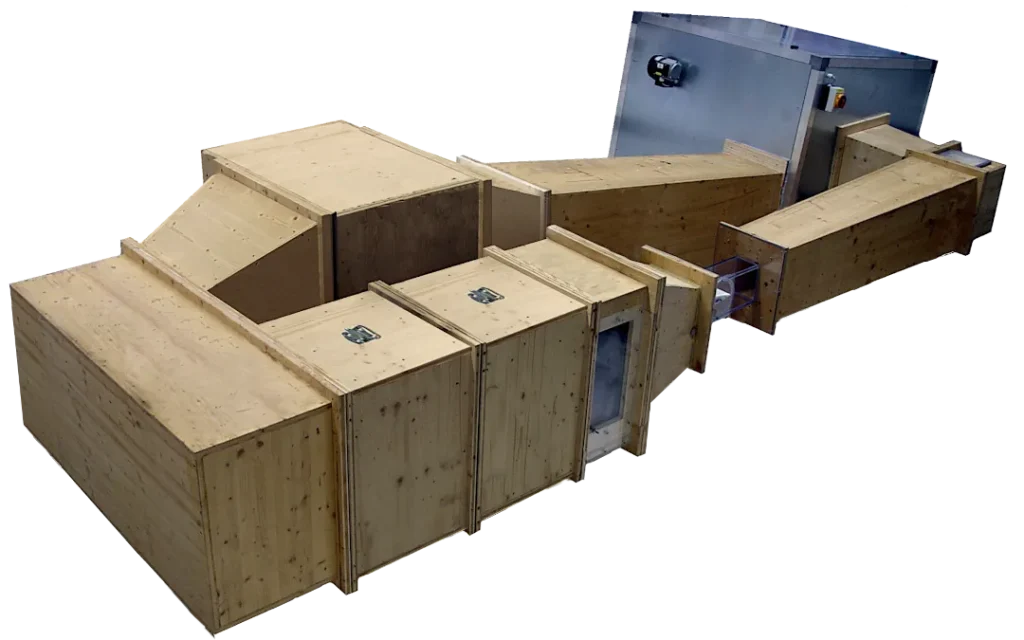
iCORE test parameters
Test section size
100 mm x 150 mm x 450 mm (W x H x L)
Total Air Temperature (TAT)
-35 °C to +22 °C
Total Air Speed (TAS)
20 m/s to 120 m/s
Median Volumic Diameter (MVD)
10 µm to 30 µm
Various icing tests can be performed with the iCORE e.g. in Rime Ice, Mixed Rime Ice, Mixed Glaze Ice or Glaze Ice conditions.
Icing Wind Tunnel Test Services & Key Capabilities
The iCORE icing wind tunnel test facility enables controlled investigation of icing processes for aerospace components, surfaces, sensors and materials under defined airflow, temperature and droplet conditions.
Key capabilities include:
- Simulation of different icing regimes (rime, mixed, glaze)
- Controlled variation of airflow, temperature, and droplet conditions
- Testing of small-scale components and surface samples
- Integration of custom test setups for application-specific investigations
The facility is particularly suited for component-level testing and rapid parameter variation.
Test Flexibility & Adaptability
The iCORE facility was designed with adaptability in mind, allowing rapid implementation of new experimental setups.
This includes:
- Custom mounting solutions for different geometries
- Integration of additional instrumentation and sensors
- Adaptation of test configurations to specific research or development needs
This flexibility enables efficient testing of a wide range of components, from simple samples to complex geometries.
Measurement & Data Quality
Testing is supported by a combination of experimental observation and measurement techniques.
Depending on the setup, this may include:
- Visual and high-speed imaging of icing processes
- Temperature and flow condition monitoring
- Quantitative evaluation of ice accretion and behavior
- Comparative testing across multiple configurations
This ensures reproducible test conditions and reliable comparison between different designs or materials.
Commercial Icing Wind Tunnel Services
Our commercial icing wind tunnel services are designed for efficient test campaigns where rapid setup, controlled parameter variation and repeatable comparison between configurations are required.
Key advantages include:
– Short setup and turnaround times
– Rapid variation of temperature, airspeed and droplet conditions
– Ability to test multiple components, coatings or configurations within a single campaign
This enables fast iteration cycles for research, product development, qualification support and comparative studies.
Typical Icing Wind Tunnel Test Scenarios
The facility is used for controlled icing investigations across aerospace components, unmanned aircraft, coatings, sensors and ice protection technologies. Test scenarios can be adapted to specific customer requirements, component geometries and development objectives.
Aircraft and Aerospace Icing Testing
Aircraft and aerospace icing testing can be performed on small components, representative surface samples and simplified geometries to investigate ice accretion, ice crystal icing, rime ice, mixed ice and glaze ice behavior. Typical examples include icing behavior of small components and surfaces, with related application topics such as Ice Accretion and Ice Crystal Icing.
UAV and Drone Icing Testing
UAV and drone icing testing supports the evaluation of small unmanned aircraft components, fixed-wing UAV surfaces, propeller-relevant geometries and ice protection concepts under controlled icing conditions. Test setups can be adapted for early-stage development, comparative studies and application-specific icing investigations.
Icing Wind Tunnel Testing for Coatings
Icing wind tunnel testing for coatings is used to evaluate how surface treatments, icephobic coatings and anti-icing concepts behave under defined icing conditions. Coating-related investigations can be combined with surface characterization and ice adhesion testing, with related application topics such as Ice Adhesion.
Component and Sensor Icing Tests
Component and sensor icing tests can be performed for small-scale hardware, measurement devices, probes and air data system components. Typical examples include testing of sensors and measurement devices, with related application topics such as Pitot Probe Testing and air data probe icing investigations.
Ice Protection System Investigations
The facility can also be used to investigate ice protection system performance, including deicing and anti-icing concepts for small components and UAV-relevant applications. Related application topics include Ice Protection Systems.
Frequently Asked Questions
What size components can be tested?
The test section has a cross section of 100 mm × 150 mm, allowing testing of small components and surface samples. Custom setups can be implemented within this space.
How quickly can tests be performed?
Due to the compact setup and adaptable configurations, test campaigns can be executed efficiently with rapid parameter variation.
Can custom test setups be implemented?
Yes, the facility is specifically designed to accommodate new setups and experimental configurations.
Is the facility suitable for development or only research?
Both are supported. The wind tunnel is used for fundamental investigations as well as application-driven testing and development support.